Vladimir Kulpinski
dipl. el. inž.
My father spent fifteen years arguing that a power grid cannot be trusted to report on itself. This is his case, in his own words, checked against his own files.
Novi Sad
The constraint
A distribution network knows what it took in and what it billed. The difference is called losses, and it comes in two kinds. Some of it is physics — heat in the conductors, iron in the transformers — and it can be modelled. The rest is energy that was consumed and never registered: connections nobody declared, meters that had been persuaded to under-report, readings taken late, or not at all. That second kind was worth tens of millions of euros a year in his province alone, and the utility could estimate the total while being unable to point at a single street where it was happening.
He put it in one line on a slide in 2012, and the quotation marks are his — the utility's own vocabulary for the thing nobody would name.
ПРОБЛЕМ НЕОВЛАШЕНОГ КОРИШЋЕЊА (“КРАЂА”) ЕЛЕКТРИЧНЕ ЕНЕРГИЈЕTHE PROBLEM OF UNAUTHORISED USE (“THEFT”) OF ELECTRICAL ENERGY
There was a second problem at the other end of the same wire, and he reached it first. On the long, thin low-voltage lines that feed farmsteads and villages, the voltage sags under load until the light dims and the motors burn out. The legal obligation to fix that sat with the distribution utility. The practical answer was a medium-voltage line and a transformer station, which cost forty to sixty thousand euros, so in practice it did not get fixed.
The device
A workshop outside Novi Sad ran a diesel generator for fifteen years because its supply was unusable. He built a model in his own workshop, then a hundred-kilovolt-ampere machine, and put it into service on 18 December 2006. It did one thing, and the numbers are his:
висина напона пре уређаја је "обарана" на око 180 V, а иза самог уређаја висина напона је остајала у опсегу вредности између 220 и 230 Vbefore the device, the voltage was being forced down to about 180 V; behind the device, it stayed in the range between 220 and 230 V.
It was tested by the Nikola Tesla Institute in Belgrade, and he quotes their conclusion rather than characterising it — a habit that runs through everything he wrote:
На основу резултата испитивања закључује се да испитивани производ ОДГОВАРА прописима и намениOn the basis of the test results it is concluded that the tested product CONFORMS to the regulations and to its purpose.
Asked whether he had invented something, he took the word apart before accepting it. This is the sentence of his I would keep if I could keep only one:
Мало је "прејак" израз изумео, али ако Ви, након свих одговора будете сматрали да је то ОК, онда ћу се ја, без лажне скромности, сложити.“Invented” is a slightly too-strong word — but if, after all the answers, you consider it fits, then I will agree, without false modesty.
He was not building a product for a workshop. He had written the general case a year earlier, in English, and the title is the whole argument: reach the far settlements along the low-voltage network they already have, and stop paying for medium-voltage line and transformation to get there.
DISTRIBUTION OF ELECTRIC ENERGY ON HIGHER DISTANCES THROUGH LOW VOLTAGE ELETRICAL NETWORKS WITHOUT THE USE OF MID-VOLTAGE POWERLINES (10 OR 10kV) WITHOUT TRANSFORMATION 10(20)/0,4kVThe same document says why he was doing it, and it is not an engineering sentence:
the electric energy isn't worthy of a man, especially not in the beggining of the third millenniumIn Serbian he was blunter about the stakes, and about what a village loses when its electricity is not good enough to live on:
"Убијање" села Србије је један од највећих проблема СрбијеThe “killing” of Serbia's villages is one of Serbia's greatest problems.
Montenegro's national utility asked to see it. The invitation names the device by its series number, which is how I know what he called the thing he built.
са вашим уређајем из серије уређаја АРП 01-10with your device from the ARP 01-10 series
The measurement
The other project ran for fifteen years and never changed its shape. In 2003 he was named to the expert team behind the national programme for reducing non-technical losses, and the method he argued for there is the method he was still refining in 2018: measure the technical losses precisely, subtract them, and whatever remains has a location. Find the location.
In February 2005 he put his name to what the utility could have held him to. It is one page, and it commits him to a result rather than an effort. It is also written in the font hack Serbian offices used before Unicode: the file on the stick reads ne}e mo}i where he typed neće moći, and the fonts that once drew it correctly are sitting in the same archive, dated 1991. What follows is transliterated back — by a function the build gate runs on the bytes it checked, not by a second copy of the sentence:
netehničkih gubitaka električne energije u takvom ambijentu neće biti i više nikada neće moći da da se uspostavein such an environment there will be no non-technical losses of electrical energy, and they will never again be able to establish themselves.
He closes it with a sentence you write when you expect to be doubted:
Ova izjava je sačinjena u svesnom stanju, bez prisile ili bilo čijeg navođenja.This declaration was made in a conscious state, without coercion or anyone's prompting.
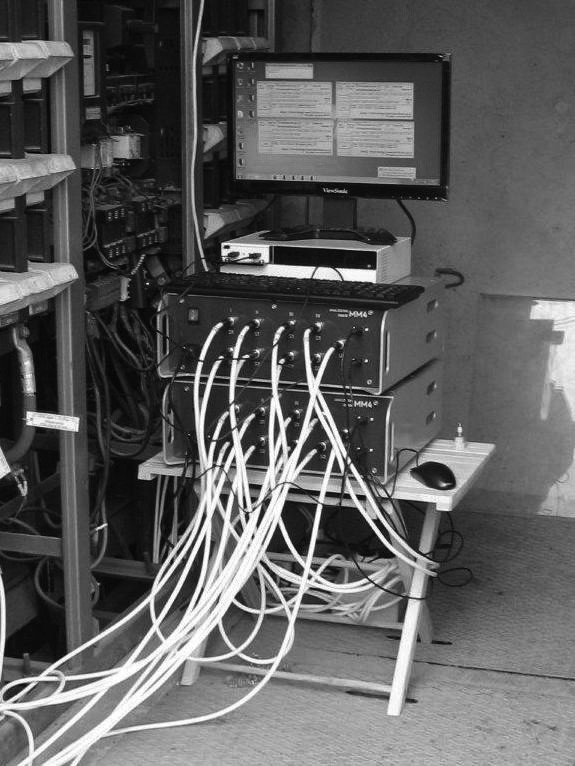
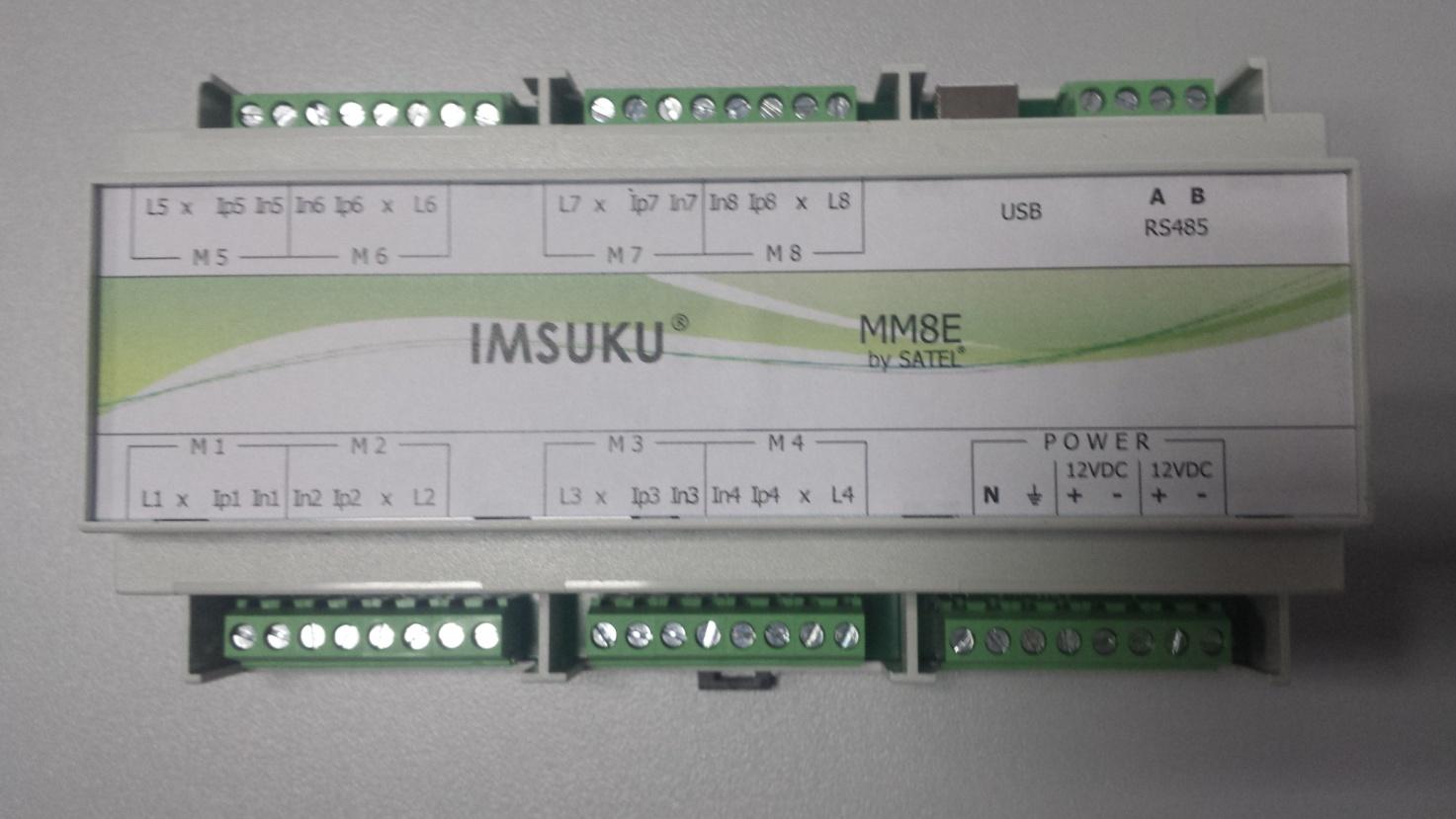
By 2010 the method had hardware behind it, built with the Chair of Measurements at the Faculty of Technical Sciences in Novi Sad. Modules in the substation watched each low-voltage feeder and timed the moment a heavy load switched on; comparing feeders placed that load on the line. His report puts the accuracy at five metres and offers bank guarantees against the whole purchase price. The utility did not answer. What he wrote instead is the closest thing to anger in the archive:
молим да се ПД ЕВ-а службено извини Катедри за мерења ФТН-а из Новог СадаI ask that Elektrovojvodina formally apologise to the Chair of Measurements of the Faculty of Technical Sciences in Novi Sad.
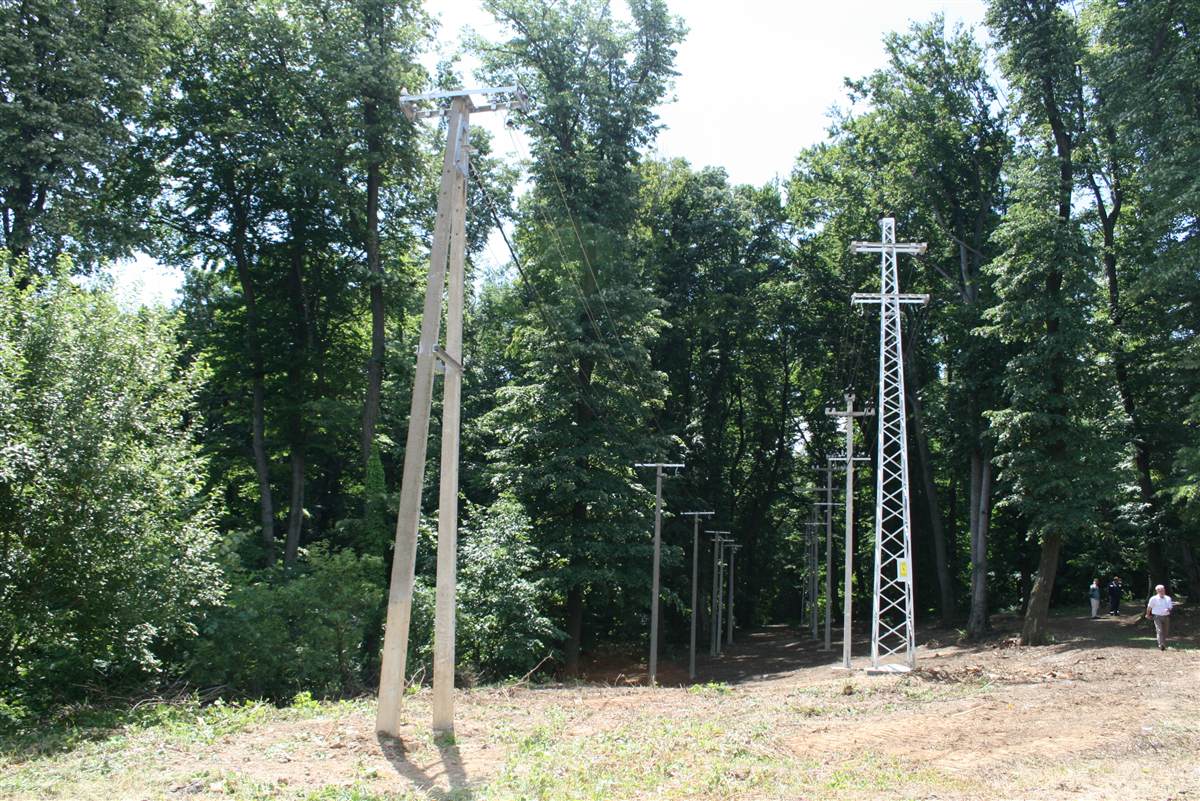
In 2012 a procurement went through for twenty-seven measuring modules, and a line of poles through woodland outside the city became the proving ground. The technical specification he wrote for it demands recognition of an appliance with better than ninety per cent reliability, and location of the point where it switched on to within three metres. The name on that specification, and on the meter specification he had written years earlier, was Venac.
A paper he wrote with professor Vladimir Vujičić for a conference in Banja Luka in November 2013 says what three metres buys you. This is the system's output, in the paper's own example — and it is printed across two columns, so the sentence reaches the page in two pieces:
potrošač na fazi R, snage 2,5 kW na stubu br. 5. trećeg vodaa consumer on phase R, 2.5 kW, at pole no. 5 of the third feeder.
That is what the specification asked for. The same paper reports the test of it — a prototype on a real line, against a load that was responsible for nine tenths of everything going unregistered there:
U postupku dokazivanja koncepta (proof of concept) u realnim okolnostima je primenjen razvijeni prototip podsistema i on je sa greškom unutar ± 3 m locirao realno opterećenje na čvoru koji je predstavljao 90 % neregistrovane potrošnje na posmatranom vodu.In proving the concept under real conditions, the developed prototype subsystem was used, and it located — with an error within ± 3 m — the actual load at the node that accounted for 90 % of the unregistered consumption on the line under observation.
What I did not expect was the thing doing the recognising. The module that turns the readings into that answer is given one sentence in the paper, and it is a sentence about machine learning, written in 2013 and running in a substation:
Treba napomenuti da ključni softverski modul PREPLOK predstavlja realizaciju algoritama prepoznavanja oblika i data mining-a i da predstavlja otvorenu strukturu koja se permanentno obučava.It should be noted that the key software module PREPLOK is an implementation of pattern-recognition and data-mining algorithms, and that it is an open structure which is permanently trained.
The same event carried the number that made it worth doing. Elektrovojvodina took in 9,039 GWh in 2012; roughly 720 GWh of it was never registered, which he priced at about thirty million euros a year — in the one company that had the lowest such losses in the country.
У 2012. ГОДИНИ ПД “ЕЛЕКТРОВОЈВОДИНА” ЈЕ ПРЕУЗЕЛА 9039 GWh ЕЛЕКТРИЧНЕ ЕНЕРГИЈЕ, ПА СУ НЕТЕХНИЧКИ ГУБИЦИ ОКО 720 GWh.In 2012 Elektrovojvodina took in 9,039 GWh of electrical energy, so the non-technical losses are about 720 GWh.
In March 2015 the work went to Zlatibor, to the thirty-first international conference of the Union of Power Engineers, and into the conference's journal — his name fourth on a paper with Vujičić, Zoran Mitrović of the same faculty, and Stojan Galić of the firm that built the electronics. The journal states that its papers are reviewed; its publishing council that year included the Minister of Mining and Energy, the director of the national utility, and the director of Elektrovojvodina. The paper reports the system as it stood in service, and the photograph in it is the only picture I have of the thing actually running.
His last paper went to the eleventh CIRED Serbia conference and is in its published proceedings — contribution I-4.13, abstract on page 138, with the expert committee's questions for discussion printed alongside. The submitted version froze in early June. His own copy did not: he kept revising through the summer, fixing a typo the printed abstract still carries, and adding a conclusion the published paper does not have. The sentence below is from that private copy, dated 29 July — the goal stated as a property of the system, in capitals, in a paper already out of his hands:
uspostavlja se potpuni nadzor nad njenim tokovima, a na način da NETEHNIČKI GUBICI NISU MOGUĆI.complete oversight of its flows is established, in such a way that NON-TECHNICAL LOSSES ARE NOT POSSIBLE.
An afternoon in September
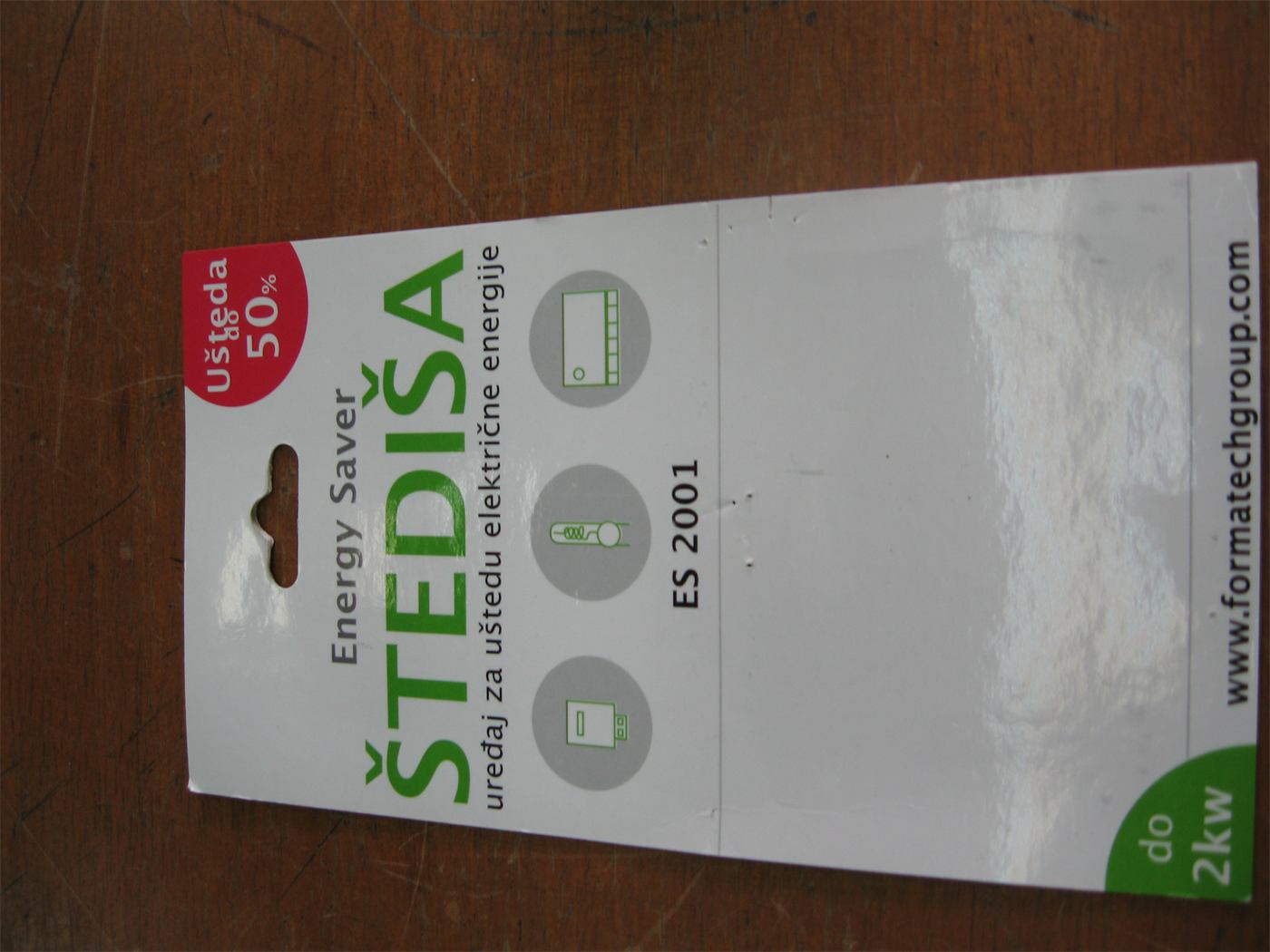
In September 2013 somebody was selling a plug-in box that promised to halve a household electricity bill. He did not argue with it. He wired nine electricity meters in series — Iskra, Čajevac, EiDE, Sagem, Sitel, whatever was in the workshop — put two immersion heaters in fifty litres of water, and ran it for an hour.
Without the box, the meters registered between 0.72 and 0.92 kWh and the water went from 20.1 °C to 42 °C. With it, they registered between 0.28 and 0.40 kWh and the water reached 29.8 °C. Roughly half the energy recorded, and roughly half the heat delivered, with a power factor that had fallen from unity to 0.78. The box saved nothing. It throttled the heater, which is a different thing — and the water is what proves it, because the water cannot be fooled by anything the meters were doing.
док се вода загрејала на 29.8 степена целзијусова.while the water heated to 29.8 degrees Celsius.
What it cost
He was not ignored. That is the part I did not know until I read the files. He got the meetings, and then he got the letters, and the letters say what he had built.
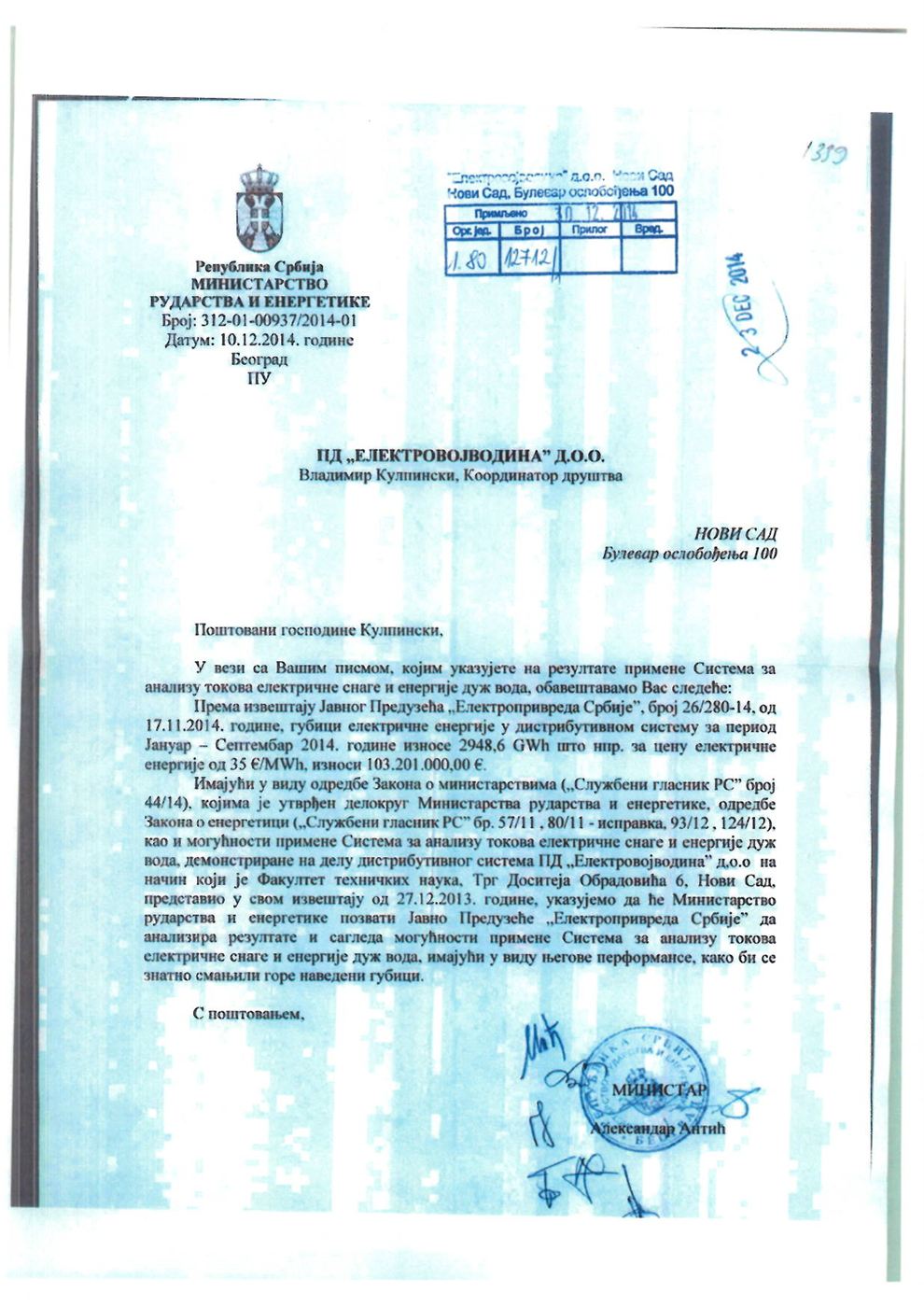
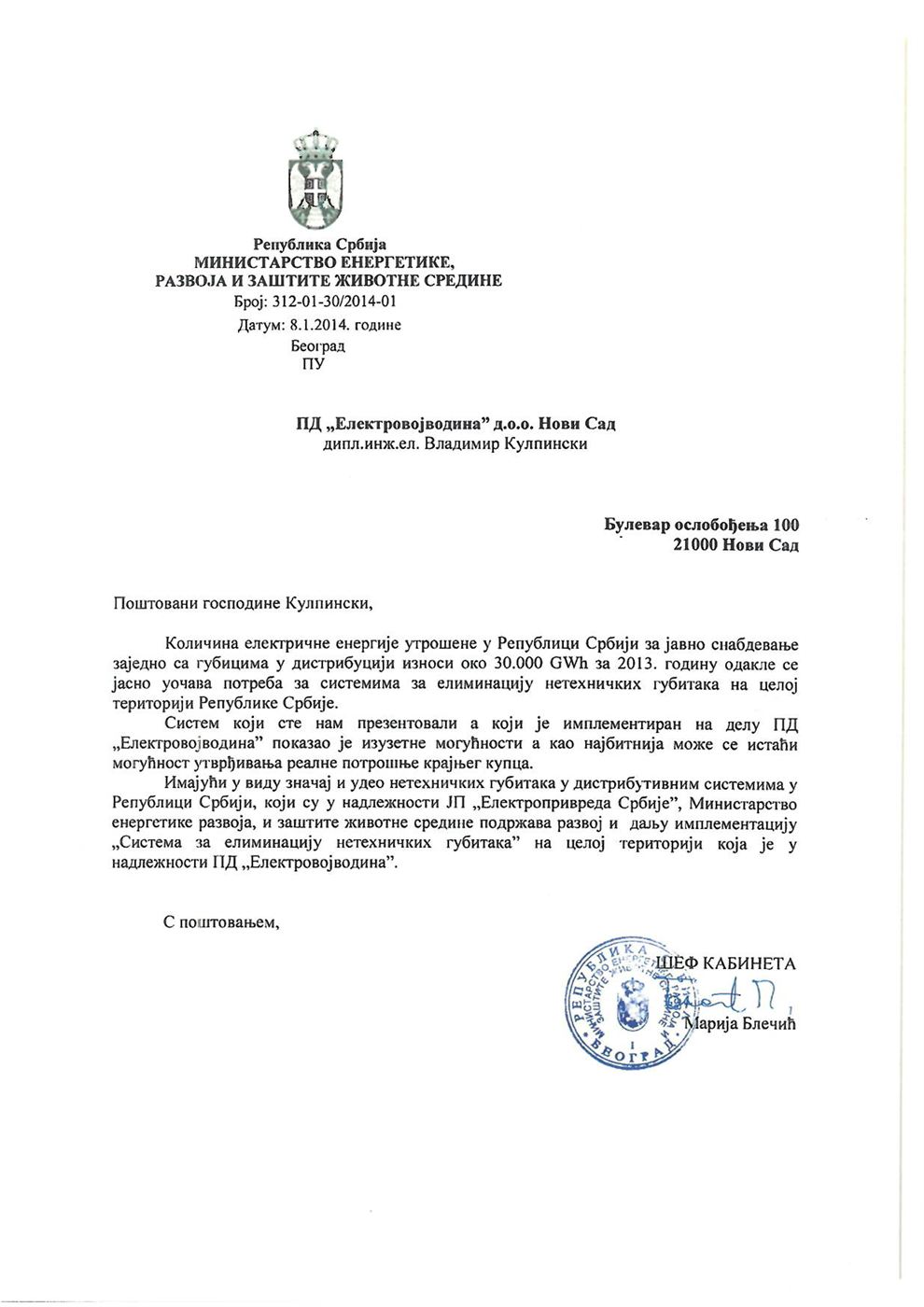
In January 2014 the ministry wrote that the system demonstrated exceptional capabilities, and singled out one: that it could establish a customer's real consumption. In December the Minister of Mining and Energy wrote to him directly, put the distribution system's losses for the first nine months of that year at 2,948.6 GWh — about 103 million euros — and undertook to call on the national utility to examine his results.
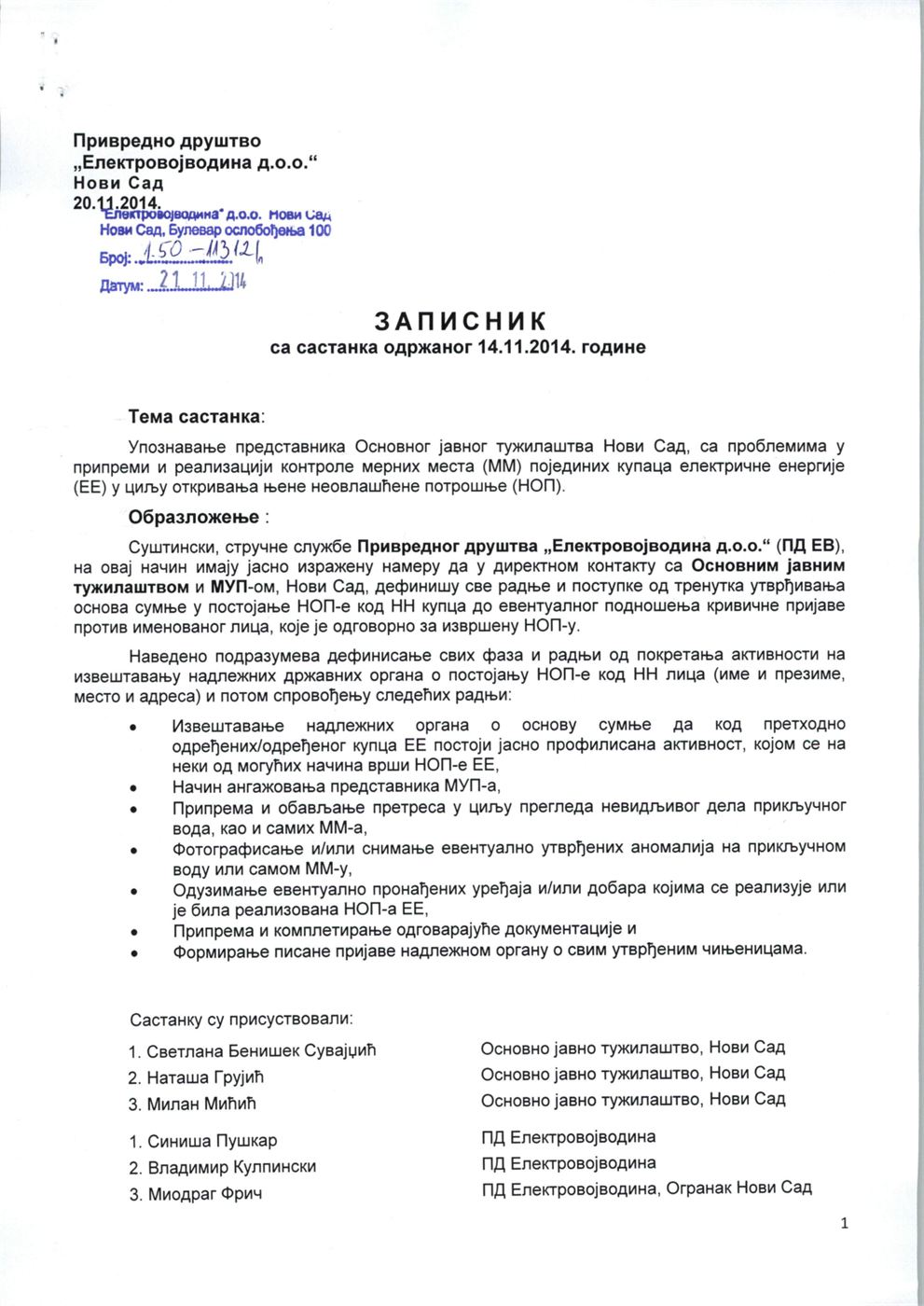
In November 2014 he sat down with three prosecutors from the Novi Sad public prosecutor's office and the police, to write down the sequence a utility must follow so that a theft it has detected can survive as a criminal case: how the suspicion is reported, how the concealed part of a connection is searched, how it is photographed, what is seized, what the complaint must contain. He had worked out years earlier that the measurement was the easy half.
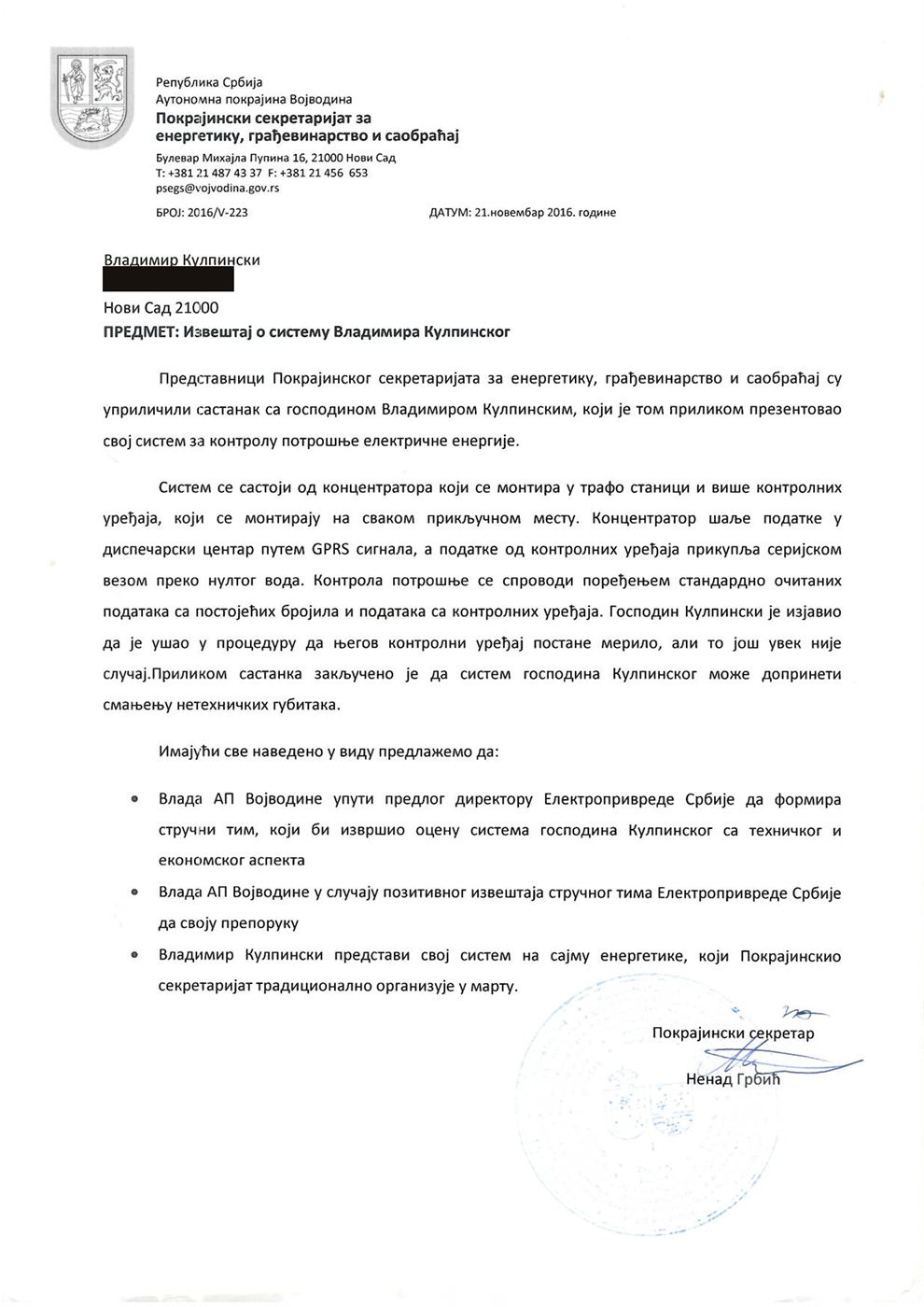
In November 2016 the provincial secretary for energy described the system in his own words — a concentrator in the substation, a control device at every connection point, data over GPRS, consumption checked by comparing the meter against the control device — and proposed that the provincial government ask the national utility to form a team to evaluate it. The same letter records, in one clause, the thing he had been chasing for a decade: that he had entered the procedure to have his control device certified as a measuring instrument, and that it had not happened yet.
Господин Кулпински је изјавио да је ушао у процедуру да његов контролни уређај постане мерило, али то још увек није случај.Mr Kulpinski stated that he has entered the procedure for his control device to become a certified measuring instrument, but that this is still not the case.
This page used to end by saying the system was never bought. That was wrong, and a paper of his I had not read when I wrote it is what corrects the record. The pilot on the Venac line worked, and the utility ordered on the strength of it:
Ovaj rezultat je omogućio donošenje odluke o nabavci 27 podsistema za merenje i nadzor nad tokovima električne snage i energije.This result made possible the decision to procure 27 subsystems for the measurement and monitoring of electrical power and energy flows.
Thirty were built. They were verified against each other on one substation rather than spread across several, so that the results would be comparable, and defined test loads were put on the lines for the same reason. By 2015 a series had been delivered, the equipment was installed by the operating team of the Novi Sad distribution, and its own operators had been trained to run the analysis without the faculty standing behind them. I have no evidence that any of it was bought from him, and the papers do not say so; what they say is that it was built, ordered and put into service.
So the ending is not that nobody wanted it. It is that a minister's signature, a prosecutor's procedure, a professor's guarantee, a provincial government's recommendation, a purchase order and a system actually running in substations were between them still not enough to change how the country measures its grid. No other distribution company took up the method, and his control device never became a certified measuring instrument — which is what the letter above says, two years after the equipment was working. The reason is not technical and it is in the record too: the losses belonged to a monopoly, and a monopoly does not bleed. It leaks, comfortably, and sends the bill onward.
What carries forward
I write firmware that is built so that it cannot overstate what it saw, and interfaces that say when a reading is missing instead of drawing a line through the gap, and a language model front door that is structurally unable to claim it checked an account it did not check. I arrived at all of it from the software side, and I did not know until this month that I had been rebuilding my father's argument in a different medium.
There is a narrower version of that, and it is the one I keep returning to. The module that identified the load was a pattern-recognition system that went on training on what it saw, and on its own its answer counted for nothing. It stood only where a second, independent measurement disagreed with the billing system, and the places it named were then opened up and checked with other instruments. A probabilistic method, bounded by something that was allowed to contradict it. I spent last year building that same arrangement around a language model, and I came at it from the opposite end.
His argument was that the grid cannot be trusted to report on itself, and that the answer is an instrument placed where nobody can reach it, reporting what it actually measured. Mine is that a system should refuse to claim more than its evidence supports. They are the same sentence. He wrote his first, in a language and a decade where it cost him fifteen years and bought him nothing.
The energy work I am building now is named Venac, after the specification he wrote and the line of poles in the woods where he tested it. This page is checked by the same gate as the rest of the site: if one of his sentences ever stops matching the file it came from, the build fails and nothing ships. It is the only thing I can still do for him that he would have recognised as engineering.